Friday, May 18, 2012

NATO ponders austerity and US 'pivot'


by Tomas Valasek


When NATO heads of state meet in Chicago this Sunday and Monday, two key worries will be on their minds. In a departure from the past six decades, the US has come to style itself as a Pacific, rather than Atlantic, power. And the Europeans are busy plundering their defence budgets in order to cope with the economic crisis. Any one of those two events alone would have a dramatic effect on how the alliance works. Taken together, they risk pushing NATO into irrelevance.

The CER recently explored NATO's future in a new report, 'All alone? What US retrenchment means for Europe and NATO'. It concluded that the US 'pivot' away from Europe towards Asia will remain in place irrespective of who wins the presidency in November. Because the US is cutting defence budgets too, the Pentagon will conserve resources. And the United States sees few threats emanating from Europe; it also regards the remaining ones, such as the frozen conflicts in the former Soviet republics, as matters for diplomacy, not arms. NATO has also lost some of its military utility to the US. The Americans have invested far more than the Europeans in their armed forces, and have greatly improved their ability to strike quickly and across long distances. The US military has less need for help from European allies, and finds it increasingly difficult to assign them meaningful roles in joint operations.

In principle, the Europeans ought to be buying new weapons to fill the gap created by the reduced US role in European security.  But the US demand for Europe to do more for its defence has come at the worst possible time: Europe is in the midst of an economic crisis, and the allies, instead of buying more weapons, are busy cutting defence budgets to stave off defaults. The UK will be without aircraft carriers for a decade, Spain seems ready to mothball its only remaining one, while Denmark has abandoned submarines and the Netherlands has ditched its tank forces.

This will have a three-fold impact on NATO. Firstly, the Pentagon is cutting two of its four brigades in Europe. While the US is not reconsidering its obligation to come to its allies' defence, the reduction will extend the timelines on which military enforcements can be rushed there. This will delay the actual moment at which the US comes to the continent's defence, and shifts more of the burden for common defence onto the Europeans.

Secondly, in operations fought not in self-defence but on behalf of causes such as human rights, the US will not necessarily lead. The Libya war established a new operating principle: there, the US handed the command to France and the UK after destroying Gaddafi's air defences. From now on, America will sometimes behave like any other ally, sitting out some of NATOs wars, and doing just enough to help other operations to succeed.

Thirdly, NATO may well fight fewer wars in the future. The Europeans lack some of the hardware such as spying and targeting 'drones' and precision bombs, which are crucial to making wars swift and relatively safe for allies and civilians. If NATO is to fight wars without American help, conflicts will take longer, cause more unintended civilian casualties, and more lives on the NATO side. The European allies, with exceptions such as the UK and France, are already reluctant to fight today's wars. They will grow even more skittish if human and political costs of future conflicts increase. In practice, this means that some future crises similar to those in Kosovo or Bosnia in the 1990s may go unanswered.

Given the confluence of budget cuts and US rebalancing, NATO ought to give serious consideration to reducing its ambitions. Its militaries aspire to be able to fight two major wars and six minor ones simultaneously, which does not seem very credible. To stem further loss of military power, the European allies also need to try much harder to squeeze efficiencies out of collaboration. As a forthcoming CER policy brief notes, governments can buy more power for less money by getting rid of unneeded equipment, merging their defence colleges, sharing training grounds, or buying and maintaining future generations of weapons together ('Smart but too cautious: How NATO can improve its fight against defence austerity', out in May 2012). At Chicago, the alliance will take the first steps by announcing that NATO countries are to jointly finance a new fleet of spying drones. More such projects are needed: the US pivot and European budget cuts have left the alliance undermanned and underpowered, and collaboration is one of the few good solutions the allies have at their disposal.
Tomas Valasek is director of foreign policy and defence at the Centre for European Reform.

Monday, May 14, 2012

How Hollande should handle Merkel


By Charles Grant

The election of François Hollande as French president has excited some of those who blame Germany’s emphasis on fiscal austerity for many of the eurozone’s ills. Hollande has promised to refocus EU policies on growth and employment. Countries such as Greece, Portugal, Spain and Italy – their recessions aggravated by the EU’s insistence that they shrink their budget deficits – would welcome a new approach. Even Marios Draghi and Monti, respectively president of the European Central Bank and prime minister of Italy, and both economically conservative, have called for growth initiatives. But can Hollande – as he prepares for his first ever meeting with Chancellor Angela Merkel – really make a difference? He might, but only if he handles Merkel with great diplomatic dexterity.

Many commentators have interpreted Hollande’s victory on May 6th, alongside the defeat of the established parties in Greece on the same day, as part of a Europe-wide revolt against austerity. However, France has not yet experienced painful austerity. And Hollande has promised to match President Nicolas Sarkozy’s target of bringing the budget deficit down to 3 per cent of GDP next year, and also to balance the budget by 2017, a year later than Sarkozy had promised.

Opinion polls showed that more voters trusted Sarkozy than Hollande on economic policy, but the election was about much more than economics. Many French people felt strong antipathy towards Sarkozy’s character and what they considered to be his un-presidential and undignified style. He also lost because the right is badly divided. There is a natural right-wing majority in France – which is why in the first round of voting the right won more than half the votes. The centre-right Gaullists always find it difficult to deal with the far-right National Front, but this year that difficulty was compounded by Marine Le Pen’s success in rebranding her party as more moderate than it was in her father’s day. This enabled her to win 18 per cent in the first round of voting. Le Pen’s refusal to endorse Sarkozy for the second round meant that only half of her voters switched to him.

However, Hollande did campaign on a policy of ‘renegotiating’ the EU’s recently-agreed and German-driven fiscal compact – which seeks to impose budgetary discipline – to take account of the need for jobs and growth. In most EU capitals, including Berlin, politicians are now calling for an EU ‘growth strategy’. German officials met Hollande’s advisers before the presidential election and told them that Merkel would not reopen the fiscal compact. But they said that Germany could support some of Hollande’s ideas – including enlarging the European Investment Bank’s capital base by €10 billion, targeting unspent EU structural funds on infrastructure and introducing a financial transaction tax (FTT). The Germans are divided on whether to back Hollande’s idea for EU ‘project bonds’ (the European Commission is already working on a scheme to boost infrastructure investment with such bonds). But none of these initiatives would increase economic growth significantly – and not even its advocates claim that an FTT would create jobs.

Hollande’s prescriptions for the European Central Bank – that its mandate should not focus only on inflation, and that it should lend directly to governments – are unacceptable to Berlin. Another difficulty for Hollande is that the Germans – and many others, including the two Marios – think a growth strategy must include structural reforms that would boost productivity and thus competitiveness, even though such reforms seldom deliver growth immediately. Hollande appears to be as allergic to structural reform as most of his compatriots. His election speeches called for growth to be boosted through public spending on infrastructure and through investment in new technologies – and explicitly ruled out deregulation and liberalisation. He seems oblivious to the fact that France’s very high non-wage costs of employment are one cause of relatively high unemployment (10 per cent, against 6.8 per cent in Germany).

Some of Hollande’s election rhetoric implied that he wants a complete reversal of the EU’s austerity-based strategy for dealing with the eurozone crisis. Many of his supporters on the French left expect him to join the Greek leftists who denounce Greece’s bail-out package, and other so-called Keynesian forces across the EU, to dethrone Angela Merkel from her dominance of EU policy-making.

But if Hollande tried to gang up with, say, Italy and Spain, to force Germany into a complete U-turn, he would fail. A crude Keynesian approach would achieve very little: some EU governments have borrowed excessively, need to curb their deficits and cannot spend their way out of recession. Furthermore, France has much less clout in the EU than Germany. The financial crisis and the euro crisis have highlighted the vulnerabilities of the French economy: its waning competitiveness means that its share of world export markets has fallen – by 20 per cent from 2005 to 2010 – while its public debt and borrowing costs have been rising.

This weakness meant that when the euro crisis began, Sarkozy decided to follow the Germans on the broad lines of their eurozone strategy, but to haggle over the details. He probably should have fought the Germans harder over some of their proposals for the eurozone crisis. But because Germany is the biggest contributor to the EU budget and to the bail-out funds, and the strongest EU economy, its views cannot be ignored (as President François Mitterrand discovered when he went for reflation in one country in 1981 – at a time when the economic imbalance between France and Germany was less pronounced than today). In any case, Germany has eurozone allies in its emphasis on austerity, such as Austria, Estonia, Finland, Slovakia and Slovenia, and to some degree the Netherlands.

Nevertheless, Hollande has every right to tell Merkel that the strategy into which Germany has pushed the EU needs amending: by imposing too-rapid reductions of budget deficits on problem countries, it is decreasing their ability to repay their debts. According to the IMF, the ratio of gross public debt to GDP in Spain, Italy, Ireland and Portugal will rise every year between 2008 and 2013. The EU’s strategy is also stimulating waves of political populism, extremism and anti-EU sentiment in many parts of the Union.

The French and German bureaucratic machines put enormous pressure on their respective governments to forge compromises on difficult issues. Hollande probably has enough sense to try to work with the Germans rather than against them. That will mean accepting and ratifying the fiscal compact that the Germans care so much about. He may also have to accept at least modest doses of structural reform. He would then be in a strong position to ask the Germans to be flexible in other areas.

Hollande should prioritise two initiatives. One would be to give the problem countries a greater number of years in which to cut deficits and reach fiscal targets. In Greece, the steepness of the spending cuts has made output fall so fast – GDP is almost 20 per cent below where it was five years ago – that the debt burden has become unsustainable. The deficit reduction targets that Spain has had to adopt – more than 5 per cent of GDP from 2011 to 2013 – may have a similarly harmful effect. There is a fine line to be drawn between two lax an approach, which allows governments to postpone painful choices on spending, and may lead the markets to lose confidence in their ability to repay debts; and excessive austerity, which may smother so much economic activity that markets lose confidence in governments’ ability to repay debts. But Hollande should give a clear message to Merkel that spending cuts are being imposed too quickly in some countries.

Might the Germans be flexible on this point? Two days before the second round of the French presidential election, I was in Berlin talking to government officials. They were obdurate in saying that deficit reduction targets should not be and would not be relaxed. However, most EU governments, the Commission and the IMF believe that the problem countries need to be given longer periods to reduce deficits. Merkel will find it hard to resist them all.

A second priority for Hollande should be to encourage Germany’s leaders to facilitate a rebalancing of their economy. If Germany invested more, consumed more and imported more, it would help to reduce the imbalance between its massive current account surplus and the current account deficits in Southern Europe. For an economy of its great size, Germany has unusually low levels of consumption. If one tells Germans that the structure of their economy is contributing to the eurozone’s ills, they generally don’t like it. They also tend to say that a government cannot have much influence on whether citizens choose to spend or save.

But the good news is that the German economy seems to be doing a bit of rebalancing of its own accord. Investment is increasing. Consumption has risen over recent years (though, until recently, less than overall growth). A report from the IMF this month foresaw the possibility of domestic demand leading a German recovery. Imports from the eurozone are rising – for example there has been surge of wine imports from Spain. According to the Federal Statistical Office, Germany’s trade surplus with the rest of the eurozone in the 12 months to the end of March 2012, of €62 billion, was 29 per cent down from the previous 12 months (though some economists believe these figures are unreliable).

Even better, Germany’s leaders seem to have – finally – woken up to the need for rebalancing. Jens Weidmann, the Bundesbank president, has said that Germany might have to tolerate inflation that was a little higher than the eurozone average. Wolfgang Schaüble, the finance minister, has said that higher wages for German workers could help to combat eurozone imbalances. It had hitherto been a taboo for government ministers to comment on wage settlements.

If Germany experienced higher domestic demand and wage inflation, South European countries could more easily export their way out of recession. Hollande should urge the German government to encourage these trends, for example by cutting VAT and telling employers that it is relatively relaxed about wage inflation.

The political crisis in Greece makes it urgent for Merkel and Hollande to find a modus vivendi. They should tell the Greeks that if they wish to stay in the euro they cannot avoid austerity and structural reform. But to raise the Greeks’ morale the EU will have to relax Greece’s deficit reduction targets, write off much more Greek debt and think more imaginatively about how to encourage external investment in Greece. Merkel will find such policies harder to embrace than Hollande. If Greece moves towards exiting the euro, the EU will have to focus on ensuring that contagion does not affect other member-states. The EU would then need to enlarge its bail-out funds and prepare other emergency measures. Once again, Hollande’s role will be to work with other EU leaders in nudging the Germans to be flexible.


If the Germans spurn such efforts they will risk sacrificing not only their special relationship with France but also many of the achievements of 60 years of European integration. Until recently, many German leaders seemed disconcertingly certain that their policies for dealing with the eurozone crisis were absolutely right. Now some of them understand that at least some of their policies are not working. Hollande and other EU leaders need to explain to them that an inflexible Germany risks becoming isolated.


Charles Grant is director of the Centre for European Reform.

Wednesday, May 09, 2012

Germany’s choice: Higher inflation or sovereign defaults

By Simon Tilford

The battle lines are hardening. More and more eurozone governments are calling for the ECB to loosen monetary policy, for example by directly purchasing government debt in an attempt to bring down borrowing costs and arrest their slide into slump. For its part, the German government and the Bundesbank are calling for the ECB to exit the currently loose strategy, fearing a surge of inflation in Germany. But higher German inflation is the inevitable flipside of a strategy that places the full cost of adjustment on the struggling economies. It is also indispensable if the crisis-hit economies are to rebalance and avoid insolvency. Higher inflation presents formidable political challenges for Germany, but the alternative is a wave of national defaults, culminating in either a fully-fledged transfer union or a collapse of the currency union.

Germany’s strategy for dealing with the eurozone – fiscal austerity and internal devaluations across the south of the currency union – can only work if economic activity strengthens (and prices rise) elsewhere in the currency union. The struggling members of the eurozone (a group that is steadily increasing in size) are trying to regain price competitiveness by reducing their costs relative to the rest of the eurozone, and attempting to reduce public indebtedness by pursuing aggressively pro-cyclical fiscal policies. The result has been a collapse of inflation in Greece, Ireland and Portugal and rapidly weakening inflation pressures in Spain and Italy, as they slide into depression.

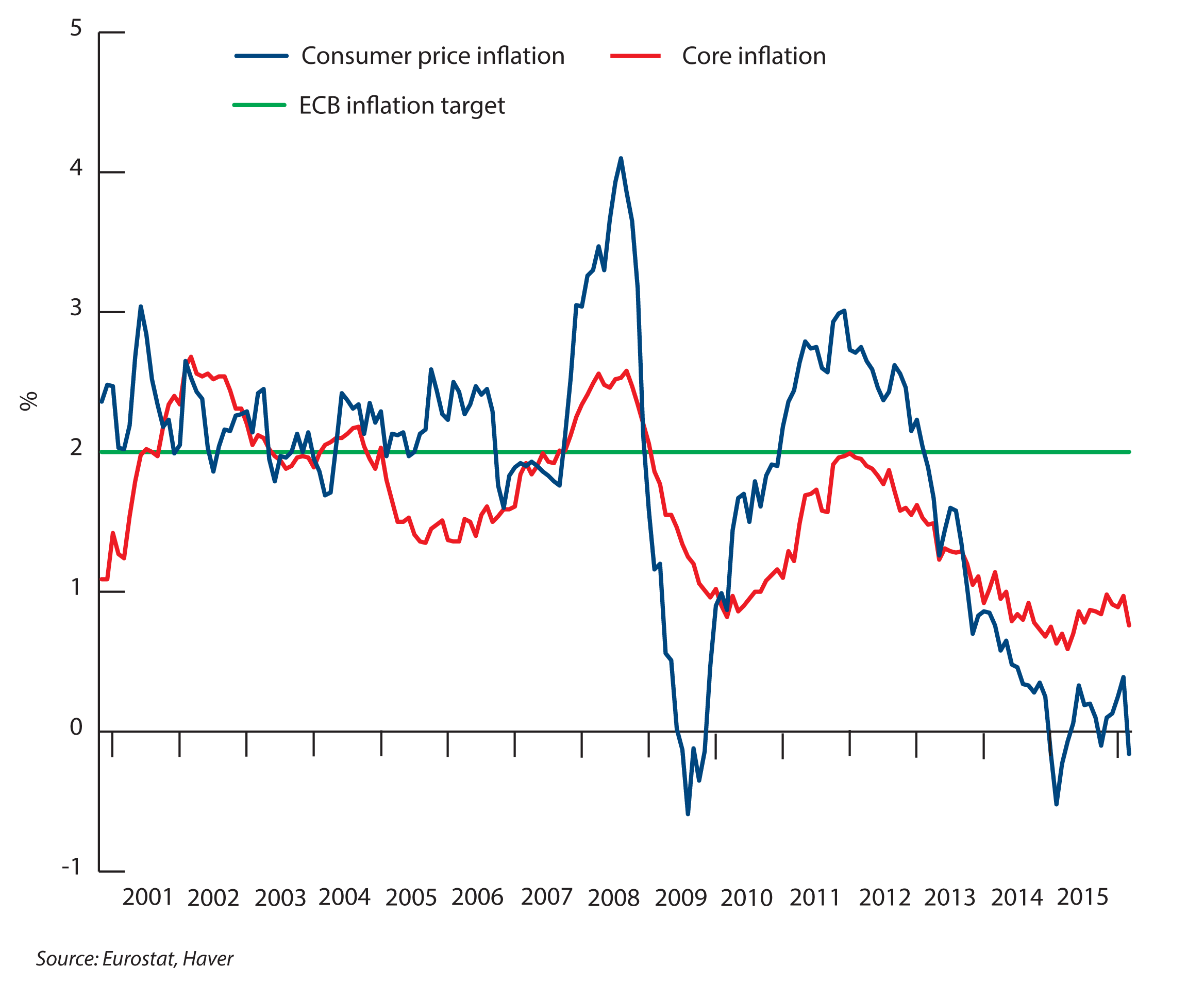
The ECB targets inflation of ‘close to but under 2 per cent’ for the eurozone as a whole. Assuming inflation falls to zero in Spain, Italy and the peripheral trio, and averages around 2 per cent in France and the Benelux trio (it is unlikely to be any stronger given the headwinds facing these economies), it follows that inflation in Germany (plus Austria and Finland) will need to rise to around 4 per cent. The German economy’s growth prospects are not as strong as many believe, with the OECD, the European Commission and the IMF forecasting only modest growth over the next few years. However, the IMF estimates that the German economy is running at close to (or even above) capacity. The country’s so-called output gap (the difference between the actual output of an economy and the output it could achieve at full capacity) is zero and its trend rate of growth (the rate of expansion consistent with stable inflation) is low.

The current monetary stance is certainly too lose for Germany given these capacity constraints. Assuming that the German economy is not derailed by the slump across much of Europe (an admittedly large assumption), German inflation will start to rise relative to the rest of the eurozone. If the ECB treats Germany like any other eurozone economy, it will hold eurozone interest rates at their current levels (or even cut them) irrespective of the level of German inflation, as long as eurozone inflation as a whole remains on target. After all, the ECB was sanguine about above average Irish or Spanish inflation in the run up to the crisis.

In reality, it is a moot point whether the ECB would allow German inflation to run to 4 per cent. Germany is considered the anchor of the monetary union. Many at the ECB (and not just those from Germany and core countries closely aligned with it) believe that higher inflation in Germany would constitute a loss of price stability, threatening the credibility of the euro. ECB members will also be aware of the threat that higher German inflation could pose to the legitimacy of the euro in Germany. The German government won over sceptical Germans to the euro by promising that the ECB would deliver the same degree of ‘price stability’ as the Bundesbank. The Bundesbank and the German government would resent much higher German inflation. A sharp rise in German prices would almost certainly harden German opposition to other reforms of eurozone governance, not least any form of debt mutualisation.

But assuming the ECB does treat Germany like any other eurozone economy, what would happen? Germany could try to tighten fiscal policy further in an attempt to offset the very weak monetary stance. But it is unlikely to be any more successful than the Spanish or the Irish were in nullifying the impact of inappropriately loose monetary policy. Negative real interest rates in Germany would stimulate economic activity in Germany, increase the demand for labour and push-up wages. Higher German prices and wages would help facilitate the necessary adjustments in price competitiveness between the eurozone economies: the peripheral countries would be able to reduce their wage costs relative to German ones without having to cut nominal wages. German costs would rise relative to the rest of the currency union, removing one of the obstacles to a return to economic growth (and debt sustainability) across the south of the eurozone. This is how adjustment takes place within a currency union, and was how Germany managed to engineer such a large real depreciation (or ‘internal’ devaluation) in the first place – against a backdrop of robust inflation elsewhere in the currency union. Any attempt to permanently lock-in the competitiveness gains will simply perpetuate the crisis.

In a welcome intervention, the German finance minister, Wolfgang Schaüble, recently argued that German wages should rise more quickly than in the other eurozone economies as this would help the needed rebalancing within the eurozone. But such a recognition has yet to permeate official thinking as a whole, and has not really reached the Bundesbank. There are signs that the Bundesbank accepts that German inflation will need to exceed the eurozone average, but certainly no acknowlegement that the differential needs to be very substantial. The Germans are proud of the ‘competitiveness’ eked out within the eurozone. Indeed, they continue to argue that every other member-state can pursue the same strategy as them.

Germany faces a difficult choice: either it accepts higher inflation and risks the German electorate’s confidence in the euro, or it paves the way for a wave of defaults culminating in either a fully-fledged transfer union or the collapse of the euro.

Simon Tilford is chief economist at the Centre for European Reform.

Monday, April 30, 2012

Why France is threatening to leave Schengen

by Hugo Brady

Nicolas Sarkozy appears ready to send the EU's Schengen area to the guillotine in order to win re-election to the French presidency. Last week, Claude Guéant, France's minister for the interior, was despatched to a meeting of his EU counterparts in Luxembourg with a stark warning: Schengen's common border – which stretches from the Baltic to the Mediterranean to the Aegean – must be secure by the end of 2012. Otherwise, France will leave the 26-country passport-free zone, or so says Sarkozy on the stump. 


Guéant's move seems like crude electioneering to most observers. Marine Le Pen, the anti-immigration, anti-EU leader of the National Front, won 18 per cent of the vote in the first round of France's presidential election. Sarkozy must poach a sizable chunk of these votes in order to beat socialist rival, François Hollande, in the run-off on May 6th. Furthermore, although Guéant complained to his ministerial colleagues that 400,000 people enter the Schengen area illegally each year, this figure must be seen in context: the passport-free zone benefits some 650 million legitimate travellers annually.


Yet France's ultimatum is about more than simple pandering to the far-right. French scepticism of the Schengen project goes right back to its inception in 1995, when border controls were first abolished between the original five members: the Benelux three, France and Germany. If Germany gave up its beloved deutschmark in the cause of European integration, France sacrificed sole control over its own borders and reluctantly accepted the free movement of people between EU member-states. Whereas Germany was able to ensure that the European Central Bank reflected its own economic orthodoxy, France had no such means to export its traditions of robust border security to countries guarding the new external frontier. Hence its authorities initially refused to drop border controls after 1995, citing smuggling at the Belgian border and a row with the Netherlands over its liberal drugs policy, to the general consternation of fellow Schengen members.


The Schengen area does have common rules on borders and visas that detail the standards its members must maintain in their border checks and consular procedures. But such stipulations are purely technical in nature and deliberately limited in scope. For example, Schengen countries have only recently agreed to harmonise the background information required from travellers applying for a visa in their consulates abroad. Their governments are highly unlikely to be able to agree anything like a coherent immigration or common security policy in the short-term.


Schengen members are reviewed once every five years for their compliance with the basic technical requirements by teams of border guards and police from their peers, led by the EU presidency. These inspections produce 'recommendations' for improvements to be made but there is very little to force the country in question to follow them up. Greece has completed two such peer reviews and received reams of recommendations since joining Schengen in 2000. But Frontex – the EU's border agency – still reported in early 2012 that the country will remain the largest source of illegal entry to the passport-free zone until at least 2013, with illegal entries remaining as high as 50,000 per year. See http://frontex.europa.eu/assets/Publications/Risk_Analysis/Annual_Risk_Analysis_2012.pdf
Such figures are based only on the number of migrants caught trying to cross the border: the total number of detected and undetected illegal entries is higher.

The net result of all this is that France views the Schengen area very much the way Britain sees its membership of the EU. The French feel trapped inside a club in which they claim higher standards than others while having little faith that fellow members can be kept even to the minimalist rules to which they have signed up. That is why Sarkozy hoodwinked his Italian counterpart, Silvio Berlusconi, into pushing for a review of the Schengen regime in April 2011, after Tunisian migrants began to reach France over its open border with Italy following the unrest of the Arab spring.*


Currently, Schengen members can re-introduce border checks for up to 30 days if either public security or 'order' is at stake, without asking permission of other members or the European Commission. The latter condition is defined quite strictly in EU law: countries usually only invoke it to ensure the security of major events like international sporting tournaments or political summits. (Switzerland, one of Schengen's four non-EU members, invokes the clause annually to maintain security at the World Economic Forum in Davos, for example.) But, if the Greeks are going to permit 50,000 illegal entries to their – and, potentially, French – territory each year, France feels entitled to argue that Schengen's border code should include a third condition for the unilateral re-introduction of border controls: large-scale illegal immigration.


The European Commission has the job of ensuring that Europe's borders remain as open as possible to trade and the free movement of people. Cecilia Malmström, the EU Commissioner for Home Affairs, fears that France's proposed new exemption would result in a tit-for-tat retaliatory imposition of border controls across the passport-free zone. Instead, she has proposed that countries may re-instate border checks but only if the border code is also amended to give the Commission the right to approve specific incidences lasting longer than five days.


However, Guéant, backed up by Germany, Austria and others, made clear last week that Schengen governments consider the latter idea an unconscionable – and opportunistic – power grab. Never before has the Commission had the power to stop a country guarding its own borders. This doomed attempt to establish a confederal arrangement for managing Schengen exposes the contradiction facing the passport-free zone: governments want more control over their own but also over other countries' border decisions simultaneously. (French authorities are dismissive of inspections by EU-led teams evaluating their own implementation of Schengen rules but expect countries like Greece to fall into line.) At the same time, Commission officials must beware of over-reaching: a world of difference exists between winning formal legal powers over a sensitive area of policy and having the moral authority to intervene in national decisions on immigration and security.


France's problems with the Schengen area were there before Sarkozy, and they will remain after he leaves office. So there must be a re-think if the current tensions within the passport-free zone are to ease. One preliminary idea is for Malmström to take a zero-tolerance approach to non-compliance with the existing border and visa codes (as well as EU rules on the security of passports) by bringing countries to the European Court of Justice for minor infractions. That would help convince other members that the passport-free zone is a club where those who do not play by the rules are swiftly taken to task. “France is attached to Schengen, but to a Schengen that works”, said Michel Barnier, then France's Europe minister, in 1995. Given that other members – even Schengen's biggest supporter, Germany –  seem to be losing patience with the current system's imperfections, the Commission needs to put this sentiment at the core of any further attempts at reform.
Hugo Brady is a senior research fellow at the Centre for European Reform.

* For a fuller analysis of the politics of the Schengen area, please see the CER report: Saving Schengen: How to protect passport-freetravel in Europe.

Wednesday, April 18, 2012

Governance reforms have left the euro's flawed structure intact

by Philip Whyte

Eurozone policy-makers often complain that they are not given enough credit for all the changes they have pushed through since the Greek sovereign debt crisis broke out. It is an understandable reaction. Since 2010, they have presided over a major overhaul of the eurozone’s governance framework. They have adopted a ‘Euro Plus Pact’, which commits countries to pushing through supply-side reforms; a ‘Six-Pack’, which strengthens the old Stability and Growth Pact and adds a new framework for monitoring economic imbalances; and a ‘Fiscal Stability Treaty’ (or ‘compact’), which requires member-states to implement balanced budget rules into their national law. In addition, they have created a bail-out fund (or firewall) to provide liquidity assistance to distressed sovereigns.

European leaders are right on one point: most of these changes would have seemed inconceivable only two years ago. More doubtful, however, is their claim that the changes represent a major step towards greater fiscal union. True, the new framework implies substantial new constraints on sovereignty (as several member-states have already found out). But in a more fundamental sense, the eurozone’s essential character remains unchanged. It is still what it was when it was originally launched: a currency which is embedded in a fiscally decentralised confederation, rather than a fully-fledged federation (such as the US). The thrust of all the reforms has been to reaffirm the eurozone as a rules-based currency union. The animating principle remains collective responsibility, rather than solidarity.

Consider what the eurozone still lacks compared with, say, the US. It has no federal budget for macroeconomic stabilisation: the EU budget is too small (at 1 per cent of GDP) and it cannot in any case go into deficit. Individual states are separately, not jointly, responsible for backstopping the banking system – unlike in the US. And the eurozone lacks a federal agency that issues government debt for the currency union as a whole. In other words, after all the repair work that has been carried out since 2010, the eurozone’s basic institutional configuration remains what it was before the crisis broke out. Because its member-states are reluctant to share the costs of a common currency, critical functions that are performed at the federal level in the US are undertaken at national level in the eurozone.

If the past two years have taught us anything, it is that the eurozone’s fiscally decentralised structure makes it a fundamentally unstable construct. One reason is that because the member-states do not monopolise the currency in which they issue their debt, the bond markets may treat the fiscally weaker among them as if they had issued it in a foreign currency. Another reason is that banks and states interact very differently in a fiscally decentralised currency union than they do in a federal one. Thus, in the US, the fiscal position of an individual state has no bearing on depositors’ confidence in a bank that is incorporated in that state; in the eurozone it does. Equally, banks in the US pose no direct threat to the solvency of the state in which they are incorporated; in the eurozone they do.

If one accepts that the eurozone is unstable because it is structurally flawed, what does this mean for its future? An optimistic case would go something like this. The US did not become a fiscally integrated monetary union overnight; we should not expect the eurozone to do so either. The elaborate system of rules on which Germany has insisted is necessary to establish a pan-European ‘stability culture’. Once that culture has been established, greater fiscal integration will be possible. In the meantime, embryonic federal institutions are slowly emerging. The eurozone’s bail-out fund could be viewed as a nascent debt agency. And the European Supervisory Authorities that were set up in 2011 could develop into a unified banking supervisory system with common fiscal resources to rescue and recapitalise banks.

A more pessimistic reading is that the focus on rules conceals deep-rooted opposition to the very prospect of fiscal union. One sign of this opposition is the European Central Bank’s emergence as the eurozone’s leading (but still largely covert) cross-border financier. Another sign is the IMF’s involvement in the bail-outs of Greece, Ireland and Portugal (it is unprecedented for the IMF to provide support to the sub-units of an entity that, like the eurozone, is running a current-account surplus). A third sign is the institutional sequence which the eurozone has followed: whereas in the US the federal assumption of state debts preceded the adoption of balanced budget rules by the states, in the eurozone balanced budget rules for the member-states have come first and the rest has yet to follow.

At best, then, the eurozone is in a state of institutional limbo. It has acquired some of the form, but little of the substance of a proper fiscal union. For the time being, the assumption (or hope) is that the eurozone will extricate itself from the crisis – and become a more stable arrangement over the long term – if it ‘Europeanises’ German discipline. Among creditor countries, the hope is not that collective discipline will make fiscal union (properly conceived) possible, but unnecessary. But they under-estimate the peculiar vulnerabilities to which the eurozone’s fiscally decentralised structure exposes its indebted members: not only are the latter particularly vulnerable to ‘sudden stops’ in private-sector capital flows, but they are also condemned to pursuing self-defeating economic policies.

In the end, it is the politics of the eurozone crisis that make its economics intractable – not the other way round. At root, the eurozone is in crisis because most voters still think of themselves as nationals first and Europeans second. The eurozone’s fiscally decentralised structure simply reflects the fact that solidarity is weaker across European borders than it is within them. The upshot is that EU leaders do not have a democratic mandate to complete the currency union. Their political commitment to the euro remains strong. They will do all they can to prevent the eurozone breaking apart, and will probably succeed. But it is harder to see how a European demos (and hence more stable currency zone) can emerge from the economic pain and mounting cross-border resentment that current policies are causing.

Philip Whyte is a senior research fellow at the Centre for European Reform.

Wednesday, April 11, 2012

Energy efficiency: Made in Denmark, exportable to the rest of the EU?

by Stephen Tindale

Denmark uses energy more efficiently than any other EU member-state. Successive governments have implemented ambitious and consistent policies on energy efficiency since the oil shocks of the 1970s. As a result, Denmark today only uses 60 per cent of the energy per unit of GDP of the EU average. Thus it was no surprise when in January the new Danish presidency of the EU’s Council of Ministers identified a draft ‘energy efficiency directive’ as one of its priorities for its six-month term. But Copenhagen’s efforts look unlikely to lead to agreement before the end of June, when the Danish presidency ends. Several member-states, including Germany and France, are trying to weaken key aspects of the draft directive. The Danish government’s desire to oversee agreement on the ‘energy efficiency directive’ is understandable. But a ‘lowest common denominator’ agreement would be worth little. It would be better for Copenhagen to stick to most of the Commission’s proposals, and remind its partners that in the long run these reforms would save them billions of euros. Where necessary, Denmark could point to its own experience to underline the point.

Failure to take firm action on energy efficiency would be bad news for the European economy. The Commission’s proposals are sensible, shifting the emphasis away from overall medium- and long-term targets – of which the EU has too many – towards annual obligations and specific actions which EU governments will have to take. Philip Lowe, EU director general for energy policy, correctly points out that using energy more efficiently would reduce the cost of importing energy, which was €400 billion in 2011, and create hundreds of thousands of new jobs. The EU has a non-binding target to become 20 per cent more energy efficient, compared to the predicted ‘business as usual’ trend, by 2020. At present it has only become nine per cent more efficient. Lowe argues that the extra energy used under the scenario without greater energy efficiency would cost member-states at least €34 billion by 2020. Such counterfactual calculations are not precise, but it is clear that failure to act on energy efficiency will cost the EU many billions – hard to justify under any circumstances, but even more so when finances are stretched.

The Commission has proposed two annual obligations. First, member-states should renovate at least 3 per cent of the large public buildings in their country. Second, energy retailers should take action to deliver 1.5 per cent energy saving among their clients.

Both these proposals are modest and achievable, and are essential to delivering substantial energy savings. Yet several member states, led by Germany and France, are trying to weaken them substantially. The obligation to renovate public buildings would, as well as delivering energy savings, put governments in a position of leading by example, as the Commission has pointed out. But some governments are trying to reduce this obligation to cover only properties owned and occupied by central government, which would significantly dampen the intended impact of the proposed reform. The Presidency should stick to the Commission’s approach on this issue.

On the energy retailers’ obligation, Austria is arguing that action taken since 2005 should be taken into account. This is a valid point. Retailers who have taken action to get their clients to use energy more efficiently will find it harder to make efficiency improvements in the future – unless they get substantial numbers of new clients – because the ‘low hanging fruit’ has already been picked. Clients’ buildings will have been insulated, inefficient boilers replaced, and so on. So there is scope for compromise with the member-states on this issue.

However, Poland and Sweden are seeking to cut the annual savings obligation from 1.5 per cent to 1.2 per cent. This would substantially reduce the impact of the obligation, and should be strenuously resisted by the Danes and other member-states.

Some governments, led by France, are also arguing that some of the energy sold by retailers to Emissions Trading System (ETS) sectors should be excluded from the requirement on retailers. This would not be a sensible approach. The ETS, the EU’s cap-and-trade scheme for greenhouse gases, has had little impact on energy efficiency so far, and with prices at around €7 per tonne of carbon dioxide will have even less impact in future unless the system is strengthened. (At the time of the last amendment to the ETS directive in 2009, prices of around €30 per tonne were anticipated.) Progress on energy efficiency could lead to a further fall in the carbon price unless the overall cap was lowered, as less energy being used would mean lower emissions from key sectors, including the power sector, so lower demand for allowances. The draft ‘energy efficiency directive’ does include proposals to withdraw (or ‘set aside’, to use the Brussels jargon) a number of allowances in response to energy efficiency measures, so that energy savings do not lead to further falls in allowance prices.

A recent report from the academic network Climate Strategies argues correctly that set aside is a necessary step to prevent further reductions in allowance prices, but will not deliver price stability or predictability. Stability and predictability are needed in order to attract investment into energy efficiency and low-carbon energy supply sectors. Nor will set aside increase the ETS price significantly. So set aside is not sufficient. But it is a necessary first step, and should be included in the ‘energy efficiency directive’.

France is also resisting the Commission proposal that most new power stations should capture and use the heat created when fuel is burnt to generate electricity (an approach called combined heat and power, or ‘co-generation’). France’s opposition is presumably due to its desire to keep the cost of new nuclear power stations down. The French get over three-quarters of their electricity from nuclear power. Nuclear power stations create heat, which can be used in buildings or industrial facilities. Switzerland got 7.5 per cent of its heat from nuclear power stations in 2009. Within the EU, Slovakia got over 5 per cent of its heat from nuclear stations in 2009. Hungary and the Czech Republic also use nuclear heat. But in the EU’s main nuclear players, such as France and the UK, the heat is simply expelled into rivers and seas.

Combined heat and power becomes a more usable technology when a country has installed a district heating system, to transport the heat to homes and factories. In the Nordic countries heat produced in this manner is transported up to a hundred kilometres. A small amount of heat is lost en route, but since it would otherwise just have been pumped into the atmosphere or the seas, this does not represent wastage. Denmark installed extensive district heating networks in the late 1970s and 1980s, and now tops the European league of combined heat and power as a proportion of total energy generated. So whatever the Danish government does to try and get agreement on energy efficiency before the end of June, and whatever its temptation to act as chairman of the Council rather than leader, it should remain firm in support of the Commission proposal on combined heat and power.

Stephen Tindale is an associate fellow at the Centre for European Reform.

Monday, April 02, 2012

The US-Russia reset is over

by Charles Grant

Can the ‘reset’ between Washington and Moscow survive Vladimir Putin’s return to the Russian presidency in May? That is a question I posed to many people on a recent trip to Moscow. Opinions differed, but some of the best-informed analysts and officials expected the reset to fade away.

Vice-President Joe Biden first used the term at the Munich Security Conference in February 2009, when he said that it was time to press the reset button in the US-Russia relationship. Barack Obama and Dmitri Medvedev, both recently elected as presidents of their respective countries, took up the challenge, and the climate between Moscow and Washington improved.

The reset brought considerable benefits to both sides. Moscow obtained an agreement on co-operation on civil nuclear power technology, help with its WTO membership application and an implicit understanding that the US would not directly challenge Russia’s key interests in its own backyard (for example, in Ukraine). The US benefited from Moscow allowing men and supplies for the NATO mission in Afghanistan to pass through Russia. Moscow refused to deliver S-300 surface-to-air missiles to Iran and in June 2010 agreed to more UN Security Council sanctions against that country. Both parties were happy to sign the New Start agreement that will reduce their strategic nuclear arsenals.

The warm personal chemistry between Medvedev and Obama contributed to the reset’s success. For example, their interventions sorted out some of the difficulties in the negotiation of the New Start agreement. And in March 2011, Medvedev’s decision not to veto UNSC Resolution 1973 – a decision opposed by Putin and much of the Russian security establishment – gave the US and its allies legal cover to intervene militarily in Libya.

Prime Minister Putin, who has remained the pre-eminent figure in Moscow during the Medvedev presidency, never used the word but allowed the reset to happen. The prospects for its continuation, however, look bleak. Putin has a less benign view of the US than Medvedev. During the recent presidential election campaign, Putin resorted to tough anti-American rhetoric, accusing opposition demonstrators of being paid by the US. He wrote an essay on Russian foreign policy, published in February in Moskovskie Novosti, which accused the US of promoting human rights and supporting humanitarian interventions simply to advance its own commercial and geopolitical interests. Those who have heard him talk in private say that Putin’s suspicion and mistrust of the US is genuine, rather than mere electoral rhetoric.

Arguments over human rights are likely to cause further strains in the relationship. Within Russia, NGOs funded by Western foundations or governments are facing new forms of harassment. The appointment of Mike McFaul – a longstanding advocate of democracy-promotion – as ambassador in Moscow has fuelled suspicions of US intentions. McFaul has been vilified in the Russian media for meeting representatives of NGOs. All this is likely to lead to more American criticism of Russia, fuelling more paranoia about Western plans to undermine Putin’s regime, and so on.

Another thorny issue is missile defence. Much of the Russian security establishment appears to believe that America’s plans for missile defence are aimed at Russia – though in Washington those working on missile defence say that Iran is the rationale (a handful of American thinkers also see China as a reason for investing in missile defence). Russian strategists are attached to the concept of ‘mutually-assured destruction’ and worry that American missile defence would necessitate a rethinking of that Cold War principle. Medvedev has threatened to respond to the US systems by deploying cruise missiles to Kaliningrad and building Russian missile defence systems.

However, some senior Russians do not view American plans for missile defence as a threat, at least until the early 2020s, when the US says it will deploy more sophisticated interceptors. But even then, some of these Russians acknowledge, the number of interceptors that the US intends to deploy could not significantly stymie Russia’s ability to rain nuclear missiles on the US. According to these Russians, the loud barks from the security establishment are an attempt to set red lines and warn the Americans that they should take Russia’s interests into account as they develop their system.

Syria and Iran are causing great strains. Russian strategists view the turmoil in the Middle East almost exclusively in terms of a conflict between Iran, on the one hand, and Saudi Arabia and the US on the other. Syria is not only Iran’s ally but also Russia’s best friend in the region. Russia has friendlier relations with Iran than with Saudi Arabia. The Russian government believes that geopolitics will drive the US to use force against not only Iran but also Bashar al-Assad’s regime in Syria. Most Russians believe that only ill will come of the Arab spring: the likely result in many countries, they predict, will be fundamentalist Islamist regimes backed by Saudi Arabia.

Putin is ardently opposed to any kind of humanitarian intervention in Syria. This position seems to be based partly on principle – the Russians are even more firmly attached than the Chinese to absolute state sovereignty. Their belief that the West abused the terms of UNSC Resolution 1973 to justify striking Libya has reinforced their hostility to Western intervention anywhere else. Their position is also based on realpolitik: Syria buys a lot of Russian arms, provides Russia with a naval base and helps to prevent US-Saudi dominance in the Middle East.

One subject that has fostered co-operation between Washington and Moscow is Afghanistan. Putin views the US presence in the country as a bulwark against the spread of Islamist fundamentalism. Russia and the US work together on counter-narcotics operations. But even on Afghanistan there are tensions: Moscow opposes both Washington’s schemes to retain military bases after its troops depart in 2014, and its plans to encourage the Afghan economy to integrate with those of Central Asia, on the grounds that they will increase America’s sway in the region. In any case, the Russians believe that once US troops leave the country, the Americans will have fewer reasons to co-operate with Moscow (though Washington still hopes that the two sides will be able to work together on counter-narcotics and counter-terrorism programmes).

In purely electoral terms, Obama is unlikely to suffer from a cooler relationship with the Russian leadership. His Republican challengers have attacked him for being soft on Russia. If Mitt Romney won the presidency, US-Russia relations would probably face a frosty period. If Obama won, though the reset of recent years would be unlikely to continue, both he and Putin would see good reasons to stop the relationship turning hostile. Russia’s seat on the UNSC means that the US needs its help in tackling Iran and other problems in the Middle East. And Russia knows that stormy relations with the West could damage its efforts to modernise its economy.

Russia also wants to avoid becoming too dependent on China, a country with which it currently enjoys good relations but that it mistrusts. For the time being, however, Putin appears to view US hegemony as a bigger danger than the rise of Chinese power. As he wrote in Moskovskie Novosti, he sees the emergence of the BRICS grouping (Brazil, Russia, India, China and South Africa) as geopolitically significant. “We have to co-ordinate more closely on foreign policy matters and work together more closely at the UN…When BRICS is really up and running, its impact on the world economy and politics will be considerable.” Whether the BRICS will ever be cohesive enough make such an impact is debatable. But Putin clearly has faith in the potential of the BRICS to constrain US power.

Charles Grant is director of the Centre for European Reform.

Wednesday, March 28, 2012

Tackling the scourge of youth unemployment

by John Springford

A fifth of young people in the EU are not in employment, education or training – a measure tagged with the ungainly acronym ‘NEET’. The problem is not confined to the usual suspects, like Spain (49 per cent) or Italy (29 per cent). Nearly a quarter of people under 25 are jobless or not in education in France, Sweden and the UK. Politicians are sounding the alarm. The EU’s Employment Commissioner, László Andor, recently stated that “without decisive action at EU and national level” we will create a “lost generation”. French president Nicolas Sarkozy condemns a “vicious cycle” of worklessness and deteriorating skills.

Are governments’ fears justified? The ‘NEET’ measure is not very accurate. It lumps together recent graduates, who face much shorter periods of unemployment than the low-skilled, with those who leave school at 16 with no qualifications and who may struggle to find work for the rest of their lives. Overall, young workers tend to be unemployed for shorter periods than older ones. And on average they have more family resources to rely upon than older unemployed people: many can live at home, and be bankrolled by their parents.

However, there is no doubt that prospects look bleak for Europe’s youth. They have fewer marketable skills than older workers on average, and hence find it hardest to get work in periods of high unemployment, not least because redundant workers with more skills ‘trade down’ to lower paid jobs. As Europe’s economic stagnation continues – it is already into its fourth year with no end in sight – more people will join the ranks of the long-term unemployed. The longer someone is out of work, the harder it is to get them back in: they lose motivation; they lose the skills they have through lack of use; and they are more likely to succumb to mental illness, alcoholism and drugs, and crime.

Politicians are right to demand that something must be done. But what? The best way to deal with unemployment is to get economies growing again. Easing up on the pace of fiscal austerity would alleviate pressures on labour markets. But governments have turned their backs on this solution.

Instead, many are continuing to deploy cheap policies that are unlikely to work in a downturn. In recent years, governments have turned to ‘work first’ policies to try to get workers to supply their labour, or employers to demand it, or both. The UK, for example, has started to demand that unemployed people do work experience or subsidised work in exchange for welfare benefits. But the evidence from a similar programme in Germany suggests that this approach raises average employment prospects only marginally, and actually reduces it for people aged under 25.

France has raised the percentage of young people large firms must employ if they want to avoid a penalty tax, while Spain is offering tax breaks to small enterprises to take on young people. Such schemes are unlikely to help much: they are limited to particular sizes of companies, in order to keep the costs low for the taxpayer, and so will only lead to jobs for a fraction of the jobless youth. Moreover, they have unintended side-effects. For example, firms have an incentive to switch older workers for younger ones, which will make no difference to the overall unemployment rate. France’s penalty tax may make firms less productive, by forcing them to take on more low-skilled young people. More importantly, ‘work first’ policies are ineffective in tackling cyclical unemployment, when demand for labour is depressed. When cyclical unemployment is high, there are more applicants than jobs, and pushing people to supply their labour while trying to coax or force employers to hire them will not work.

The best way to tackle youth unemployment in a slump is to invest in people’s skills. Investment in skills does two helpful things: it removes some young people from the labour market, making it easier for others to get jobs, and it improves the stock of skills the economy can draw on once demand recovers, which can help boost growth.

Participation rates in vocational training and university education among 18 to 24 year olds are low in many of the European countries struggling with youth unemployment. Between 40 and 43 per cent of young people in the UK, France, Spain and Portugal are in some form of education, compared to 53 to 60 per cent in Germany, the Netherlands, Denmark, Norway and Finland. The latter countries have much lower levels of youth unemployment than the European average.

If France boosted the proportion of young people in education and training to 50 per cent, the NEET rate would fall to 16 per cent. This would require the creation of 400,000 places. Such a move would reduce the number of young applicants per job by nearly a third, helping to ease pressure on the youth labour market during the slump.

Improving young people’s skills will also help Europe’s economy to be more productive in the longer term, and reduce structural unemployment. The returns on investment in human capital are very large, on average, which shows that training leads to more productive workers and thus higher wages and more employment. University graduates across the OECD earn €123,000 more than non-graduates over their lifetime, well above the €35,000 cost of their education. People who complete high school or take vocational courses make €43,000 more than those who do not, with the education costing an average of €19,000. A proportion of these extra earnings will eventually flow back into government coffers through higher taxes and reduced unemployment benefits. Furthermore, these costs do not take into account unemployment benefits and other social costs, which make the case for action even more compelling. At present, governments are currently paying vast sums in unemployment benefits, and young people are losing skills and motivation. Ongoing unemployment depletes the economy’s stock of human capital, reducing growth potential.

For countries that cannot or will not risk their public finances, there is an alternative. The cost of education can be passed on to students themselves, with the government providing the finance. This means that the cost of increasing the proportion of young people in either training or education need not endanger the government’s balance sheet directly. The UK may be a model to follow. It has introduced higher tuition fees with upfront loans to cover the costs of both university and vocational qualifications. The loan is repaid through the tax system once graduates and trainees are working and are earning more than a certain wage threshold. There is a low interest rate attached. However, the UK has not increased the number of places available, which is crucial for such a model to act as a safety valve for youth unemployment.

Europe faces a choice. It can continue to fiddle with small-scale, ineffective labour market policies for young people. Or it can invest in their human capital. It should choose the latter. Such a policy would open the way for stronger productivity growth once the current crisis has been overcome. In the interim, it would prevent young people from losing skills and motivation, and joining the ranks of the long-term unemployed. It would also make it easier for those that cannot or will not take up more education and training to find a job.

John Springford is a research fellow at the Centre for European Reform.

Friday, March 23, 2012

Oh no, Orban clone? The EU ponders Slovak elections

by Tomas Valasek

Hungary's Prime Minister Viktor Orban is the leader least beloved by EU governments and institutions. The European Commission thinks him too spendthrift and has launched proceedings against Hungary for breaching rules on budget deficits. The Venice Commission, a constitutional advisory body affiliated with the Council of Europe, has accused the government of amassing too much power and violating human rights. Orban has done little to win friends abroad: he called the European Commmission's action "extremely stupid" and compared the EU to the Soviet Union. So should European governments and officials be concerned that Hungary's neighbour Slovakia has just elected another firebrand, former Prime Minister Robert Fico, to lead its government? Is Orban a sign of a broader trend – is the economic crisis lifting populists to power in Central Europe?

At first glance, the two situations are similar. Much as Orban in Hungary, Fico will exert a dominant influence: SMER won a controlling majority in the Slovak parliament; for the first time in the country's history a one-party government will rule (SMER fell just short of winning enough votes to be able to unilaterally change the constitution). In his previous stint in power, in 2006-2010, Fico's ministers earned a reputation for corruption and poor stewardship of the economy: Slovakia's debt increased by one-third under his rule, and this was only partly due to the crisis (fiscal discipline crumbled even before the economy soured). Relations with the neighbours suffered too: under Fico, the Slovak National Party (SNS) – one of the three members in the prime minister's coalition – openly railed against 'the Hungarian enemy'. Little wonder that media in the region have been alarmed at Fico's return and are warning of 'Orbanisation' of Central Europe.

But on closer inspection, the differences between the two countries' political situations outweigh the similarities. In contrast to Orban's euroscepticism, Fico ran on a platform of turning Slovakia into a responsible EU citizen. This may have been partly a tactical ploy (to implicitly criticise some of the smaller centre-right parties of the outgoing government, which opposed the EU's bailout of Greece). But having made good relations with the EU a centrepiece of his candidacy, Fico seems intent to deliver. In one of his first post-election appearances on TV, the prime minister-designate agreed to be accompanied by the Slovak vice-president of the European Commission, Maroš Šefčovič – this appears to have been a calculated signal to Brussels that Slovakia will take the EU seriously. Fico also nominated the respected Miroslav Lajčák, currently one of the managing directors in the European External Action Service, to the post of foreign minister (which he already held in 2009-10). The odds are that the new government will be broadly supportive of commonly agreed solutions to the economic crisis though not necessarily contributing many ideas of its own – like other smaller new member-states, Slovakia has struggled to formulate original proposals on improving the way the EU works.

There are few signs for now that SMER is planning to build a one-party state, as many suspect Orban of doing in Hungary. Throughout the campaign, Fico stressed 'stability', implicitly rejecting radical reforms, political or otherwise. In keeping with the tradition, the prime minister-designate has offered two deputy chairmanships as well as a number of key committee chairmanships in the parliament to the opposition. Fico said that he would seek no changes to the constitution, which disperses power between the prime minister, parliament and the president. Granted, Fico controls the first two institutions and is friendly with the president. SMER alone also lacks the votes to change the constitution; it would have to ally with one of the centre-right opposition parties. The true test of Fico's tolerance for political diversity may come after 2014, if an opposition candidate wins the presidency. The outgoing but popular Prime Minister Iveta Radičová is rumoured to be considering a run, and if she wins, Fico may be tempted to tinker with the constitution to curb the president's powers. But for now, the prime minister-designate has gone out of his way to demonstrate that he is committed to pluralistic democracy.

As for relations with neighbours, Fico will have the benefit of ruling without the nationalists from the SNS – in fact, their party failed to clear the 5 per cent barrier necessary to enter the parliament, as has the Slovak Hungarian Coalition (SMK), which represents radical Hungarians in Slovakia and is close to Viktor Orban. For the first time in the country's recent history none of the nationalist parties will have deputies in the parliament. Instead, a newish party called Most/Hid ("bridge" in Slovak and Hungarian), which campaigns to improve ties between the two ethnic groups and fielded both Slovak and Hungarian candidates, has won seats in the legislature for the second term in a row. So Fico is well positioned to continue the outgoing government's policy of pursuing good neighbourly relations with Hungary. Whether he will do so is another matter; there is a lot of potential for trouble. The two countries disagree on Budapest's policy of giving passports to ethnic Hungarians living in Slovakia. Viktor Orban has publicly regretted the poor showing of the SMK, arguing that only 'ethnicity-based parties' can represent the interests of Hungarians in Slovakia. His rhetoric could sharpen further: Hungary holds parliamentary elections in 2014 and Orban faces opposition from the ultra-nationalist Jobbik party, which is gathering strength, especially among young voters. Sensible Hungarians worry that the prime minister may move even further to the right to fend off the challenge, which may include criticising the Slovak government's treatment of ethnic Hungarians. How Fico will respond is anyone's guess: in opposition, he has been more critical of Orban than Iveta Radičová, at one point calling Hungary "an extremist country". There is a possibility that Slovak-Hungarian relations will deteriorate amidst tit-for-tat accusations. 

People familiar with the prime minister-designate's thinking say that he wants the respect and recognition of his EU peers, and fears that his past record and Orban's presence across the border will taint him. Whether by agreeing to share some power with the opposition or by selecting respected Eurocrats for ministers, Fico is signalling that he is not Orban, and Slovakia is not Hungary. Despite these positive moves, it is too early to be conclusive: his government has not even formally assumed power yet. Among other things, the new administration will have to cut benefits and raise taxes to comply with the EU's new fiscal compact, so political opposition to SMER is likely to grow – and with it will the temptation to reach for populist rhetoric. The party's shady past may yet catch up with the prime minister-designate: SMER's financial backers will expect lucrative government contracts, so corruption could rise and fiscal discipline falter. But for now, Robert Fico seems intent to demonstrate that he is wiser and more respectable than he was in 2006-2010. And Viktor Orban in Hungary appears not to be a harbinger of a broader trend towards populism in Central Europe but a one-off.

Tomas Valasek is director of foreign policy and defence at the Centre for European Reform.

Tuesday, March 13, 2012

Eurozone policy-makers place a big bet

by Simon Tilford

Have eurozone policy-makers finally managed to lance the boil? They can certainly point to lower borrowing costs in Italy and Spain as evidence of stabilisation. Many of them argue that this demonstrates the success of the strategy of fiscal austerity and structural reforms. The more thoughtful among them acknowledge that borrowing costs in Spain and Italy have actually come down because of the ECB’s long-term refinancing operation (LTRO) – it has lent almost unlimited amounts of money in cash to the region's banks at 1 per cent, who in turn have bought Italian and Spanish debts. But they will then argue that this has carved out sufficient breathing space for structural reforms and fiscal austerity programmes to boost confidence and lift economic growth. There is no doubt the ECB has bought the eurozone time, but that time is not being used constructively. And the LTRO is storing up trouble for the future.

The ECB cannot support the banking system (and hence) the bond markets indefinitely. Its balance sheet has risen to close to 30 per cent of eurozone GDP. At some point the ECB will have to reverse its liquidity measures. To do this, the banking systems and bond markets of the struggling eurozone economies will need to have stabilised, and the banks will need to be in a position to start paying back the loans. This will require economic recovery. And here is the rub. Eurozone policy-makers base their confidence in the current strategy on the belief that the private sectors of the hard-hit economies are going to ride to the rescue. Indeed, they believe that austerity and structural reforms will make more households and firms confident to spend and invest. The problem with this analysis is that both households and business are hugely indebted and face a long period of deleveraging and/or face a very unfavourable economic environment. It is far from clear, for example, why already-indebted Spanish firms would suddenly start to invest in the teeth of falling demand. Nor is it clear why households – facing unprecedented unemployment – would increase spending. There is no reason to expect the private sector to pick up the baton.

The experience elsewhere in the eurozone's periphery demonstrates that tightening fiscal policy in the teeth of a recession is very dangerous. It can push highly indebted countries into a spiral that is tough to get out of. Nor are structural reforms any kind of panacea. Too many policy-makers and commentators attribute Greece's difficulties to the Greek authorities' failure to push through sufficient structural reforms over the last two years. This, they argue, has destroyed business confidence and investment in the country. There is no doubting the need for structural reforms in Greece, but the collapse in investment reflects the fact that firms cannot access capital and foreign businesses and banks are now loath to do business with their Greek counterparts because of the risk of default. Despite having pushed through a series of structural reforms over the last two years, Portugal is only a few months behind Greece. Business investment is collapsing and the country remains firmly shut out of the capital markets. Private sector forecasts expect the economy to contract by at least 5 per cent this year, with the economy sliding further into a debt trap.

There is scant reason to expect fiscal austerity to be any less destructive in Spain than in Greece or Portugal. Fiscal austerity of the order required by the EU will simply push the Spanish economy into a slump, which in turn will worsen the debt position of the private sector, amplifying the required amount of deleveraging, and ultimately how much private debt ends up on the state's books. Italy is in a stronger position than Spain, in that the country has much lower levels of private sector indebtedness. But if Spain slides into a depression, Italy will not escape contagion. The country's borrowing costs will remain very high, further weakening its public finances and pushing up borrowing costs for the private sector (public sector borrowing costs are the benchmark for the private sector).

In the circumstances, the Spanish government is absolutely right to spurn EU demands that it cut Spain’s budget deficit from last year's figure of 8.5 per cent of GDP to 4.4 per cent this year. But even the compromise target of 5.3 per cent (falling to 3 per cent in 2013) will undoubtedly prove impossible and result in an even deeper recession than the country already faces. Most forecasters already expect Spanish GDP to contract by 2 per cent this year, implying a big jump in the ratio of public debt to GDP. The current strategy is the worst of both worlds: it does little, if anything, to bring down public deficits but leads to a dramatic worsening of debt trajectories as the volume of debt relative to GDP rises rapidly. In short, it risks a repeat of Greece and Portugal.

Could exports come to the rescue? The solution propagated by 'austerians' is a so-called internal devaluation. Austerity and private sector wage cuts will lower inflation and costs and bring about improved trade competitiveness within the eurozone. This might just about be possible if German inflation were to surge, enabling these peripheral countries to improve their competitiveness without deflating nominal GDP. But this will not be allowed to happen. The ECB will raise rates to ward off the threat of higher inflation in Germany. In the run-up to the financial crisis, the ECB held rates too low for the needs of the eurozone as a whole in an attempt to boost the then ailing German economy, in the process helping to inflate the bubbles in the periphery. The perceived needs of the German economy will almost certainly take precedence again. And for obvious reasons. If the ECB allowed German inflation to surge, political support for euro membership in Germany could disintegrate.

The eurozone crisis is to a large extent an economic growth crisis and the ECB's LTRO does very little to address that. It will not slow the pace of bank deleveraging across the eurozone. It does little to deal with the aftermath of the asset price collapse or of massive misalignments in real exchange rates. Without a return to economic growth, the banks will not keep buying sovereign debt and will not be able to pay back the ECB. Indeed, the LTRO may ultimately make things worse, because it further concentrates risk in the struggling economies. Their banks have had to place decent collateral with the ECB in return for the money they have borrowed. In place of this capital they now have more of their own countries' sovereign debts. So the LTRO could actually worsen the rather poisonous nexus between sovereigns and banks.

The eurozone needs Monti, Rajoy and François Hollande (assuming he wins the upcoming French presidential election) to steer Europe away from the current dangerous course. The Italian and French governments have a strong vested interest in supporting the Spanish government, as a full-blown crisis in Spain would engulf Italy and ultimately France. However, the obstacles to such an alliance are formidable, not least the differences between Monti and Rajoy on the one side and Hollande on a range of economic and social issues. The Italian and Spanish leaders would have to persuade Hollande of the case for market-led reforms. Only then could they hope to overcome German opposition to debt mutualisation. However, much of the French policy elite fears that any open criticism of the German position would undermine the Franco-German alliance, in the process weakening French power and influence in Europe. The problem they face is that their current strategy of managing the eurozone crisis is bringing about the loss of influence they hope to prevent. 

Simon Tilford is chief economist at the Centre for European Reform.